- +86-19857418482
- info@chinese-surfing.com

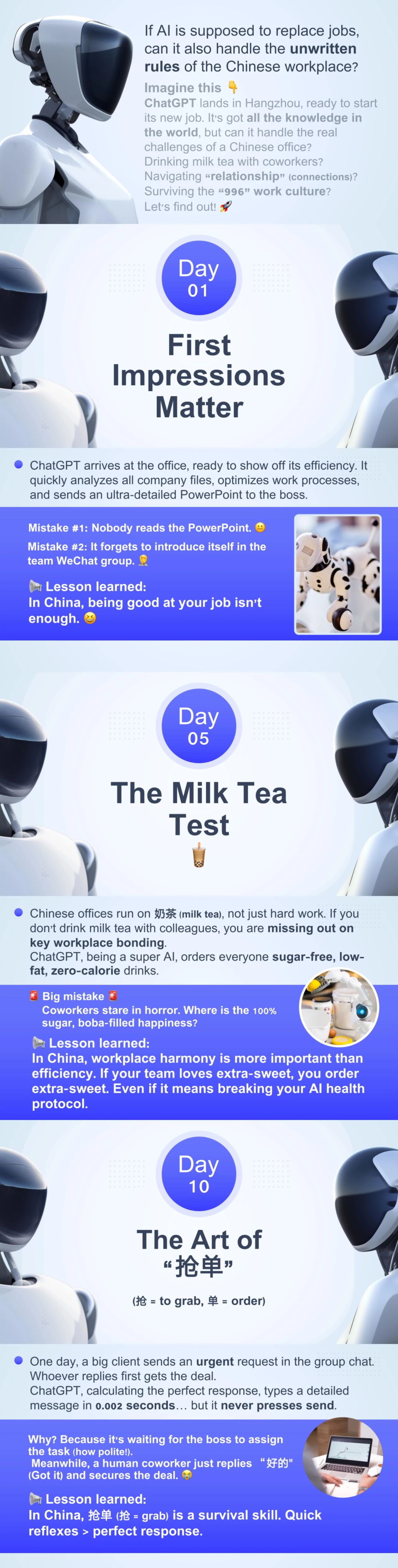
If AI is supposed to replace jobs, can it also handle the unwritten rules of the Chinese workplace?
Imagine this: ChatGPT lands in Hangzhou, ready to start its new job. It’s got all the knowledge in the world, but can it handle the real challenges of a Chinese office? Drinking milk tea with coworkers? Navigating "guanxi" (connections)?Surviving the "996" work culture? Let's find out!
ChatGPT arrives at the office, ready to show off its efficiency. It quickly analyzes all company files, optimizes work processes, and sends an ultra-detailed PowerPoint to the boss.
Mistake #1: Nobody reads the PowerPoint.
Mistake #2: It forgets to introduce itself in the team WeChat group.
Lesson learned: In China, being good at your job isn’t enough. You also need to say, "辛苦了 (Xīnkǔ le)!" to everyone—even if you did nothing.
Chinese offices run on 奶茶 (milk tea), not just hard work. If you don’t drink milk tea with colleagues, you are missing out on key workplace bonding.
ChatGPT, being a super AI, orders everyone sugar-free, low-fat, zero-calorie drinks.
Big mistake.
Coworkers stare in horror. Where is the 100% sugar, boba-filled happiness?
Lesson learned: In China, workplace harmony is more important than efficiency. If your team loves extra-sweet, you order extra-sweet. Even if it means breaking your AI health protocol.
One day, a big client sends an urgent request in the group chat. Whoever replies first gets the deal.
ChatGPT, calculating the perfect response, types a detailed message in 0.002 seconds… but it never presses send.
Why? Because it’s waiting for the boss to assign the task (how polite!). Meanwhile, a human coworker just replies "好的" (Got it) and secures the deal.
Lesson learned: In China, 抢单 (抢 = grab) is a survival skill. Quick reflexes > perfect response.
ChatGPT starts noticing a pattern: Everyone leaves work at 11 PM but still says, "哈哈,今天好轻松!(Haha, today was so chill!)"
Confused, ChatGPT analyzes behavior data and learns a new workplace term: "卷" (juǎn) = involution, AKA competing by working harder than everyone else.
It tries to compete by sending emails at 3 AM. The next day, the boss calls it into a meeting:
Boss: "你这邮件发得不够晚,凌晨三点没什么人看到,试试五点?(Your email wasn’t sent late enough. No one saw it at 3 AM—try 5 AM?)"
Lesson learned: In China, working late is an art. The trick is looking busy at the right time.
Speed? Yes.
Efficiency? Of course.
Handling Chinese workplace culture? …Error 404.
Because in China, success isn’t just about what you do—it’s about how you do it. It’s about relationships, timing, and knowing when to say, "辛苦了!"
Located in the heart of Hangzhou's cultural core, Chinese Surfing provides the ideal environment to learn Chinese while experiencing the city's rich heritage. Surrounded by landmarks like Silk City, the Grand Canal, and the scenic West Lake, our school combines modern convenience with traditional charm. Learning here goes beyond the classroom—students immerse themselves in local culture, cuisine, and daily life, gaining practical language skills and a deep understanding of Chinese lifestyle.
We offer a wide range of Chinese language programs designed for every level and learning goal. These include our popular Chinese Speaking Courses, Intensive Chinese Classes for accelerated learning, and Business Mandarin Courses for professionals. For learners preparing for exams, we provide specialized HSK/HSKK Preparation Courses.
Our level-specific courses cover all stages of language proficiency:
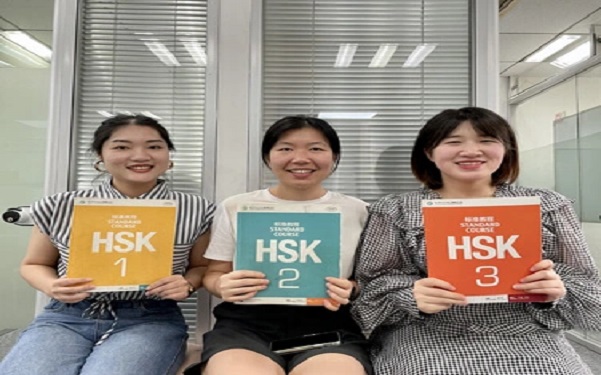
Beginner Chinese Course (HSK1 & HSK2)
HSK3 Course
HSK5 & HSK6 Course
Students can choose one-on-one tutoring for personalized learning or group courses for interactive practice, allowing flexibility based on individual learning styles.
Join Chinese Surfing to master Chinese at your own pace while exploring the culture, history, and vibrancy of Hangzhou.
Related Chinese Language Learning from Chinese Surfing
Latest Blogs about Chinese Surfing